

What is the elongation at break of Rubber Washer HNBR?
Jan 05, 2026
Hey there! As a supplier of Rubber Washer HNBR, I often get asked about different properties of these amazing products. One of the key questions that keeps popping up is about the elongation at break of Rubber Washer HNBR. So, let's dig into it and find out what it's all about.
First off, what exactly is elongation at break? Elongation at break is a measure of how much a material can stretch before it breaks. It's an important mechanical property, especially for rubber washers. When we talk about Rubber Washer HNBR, elongation at break tells us how far we can stretch the washer until it snaps.
HNBR, or Hydrogenated Nitrile Butadiene Rubber, is known for its outstanding properties. It combines the good resistance of nitrile rubber to oil and fuel with excellent heat, ozone, and weather resistance. This makes Rubber Washer HNBR a top - choice in many applications, like automotive, oil and gas, and even some industrial machinery.
The elongation at break of Rubber Washer HNBR can vary based on a few factors. The formulation of the HNBR plays a huge role. Different additives and curing agents can change the way the rubber behaves under stress. For example, if more reinforcement agents are added, the rubber might be stronger but could have a lower elongation at break.
Another factor is the manufacturing process. How the Rubber Washer HNBR is molded, cured, and finished can affect its final properties. If the curing process is too fast or the temperature is not right, it might lead to a less - than - optimal elongation at break.
Now, generally speaking, the elongation at break of Rubber Washer HNBR can range from around 300% to 500%. This means that in ideal conditions, the rubber washer can stretch to three to five times its original length before breaking. This high level of elongation is really useful in applications where the washer needs to adapt to different shapes and sizes without failing.
Let's compare it with some other types of rubber washers. First, take a look at Rubber Washer EPDM. EPDM, or Ethylene Propylene Diene Monomer, has good weather and ozone resistance. However, its elongation at break can be different from HNBR. EPDM might have an elongation at break in the range of 200% - 400%. So, in some cases, Rubber Washer HNBR can stretch more before breaking.
Then there's the NBR Black Rubber Washer. NBR is a common rubber material known for its oil resistance. But the elongation at break of NBR black rubber washers can be around 250% - 450%. Again, Rubber Washer HNBR often has an edge in terms of being able to stretch further.
And don't forget about the Silicone Rubber Washer Black. Silicone rubber is great for high - temperature applications and has good electrical insulation properties. However, its elongation at break typically ranges from 100% - 300%, which is generally lower than that of Rubber Washer HNBR.
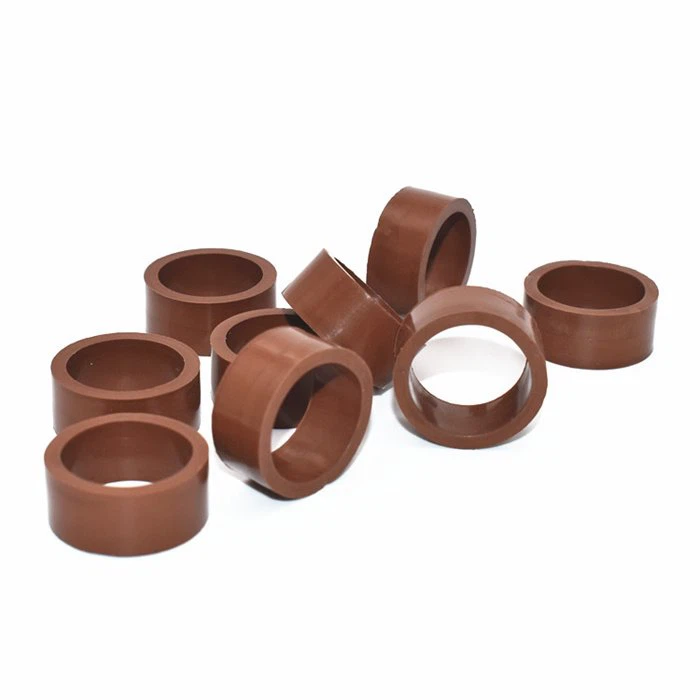

Why is the high elongation at break of Rubber Washer HNBR so important? Well, in real - world applications, washers often have to deal with a lot of stress. For example, in automotive engines, rubber washers are used in various seals. As the engine heats up and cools down, the metal parts expand and contract. The rubber washer needs to stretch and contract along with them without breaking. The high elongation at break of Rubber Washer HNBR ensures that it can handle these changes in shape and size without failing, which is crucial for maintaining a good seal and preventing leaks.
In the oil and gas industry, Rubber Washer HNBR is used in pipes and valves. These components are often subject to high pressure and temperature changes. The ability of the rubber washer to stretch and adapt to these conditions helps in preventing any fluid leakage, which could be extremely dangerous in this industry.
So, if you're in a situation where you need a rubber washer that can handle lots of stretching without breaking, Rubber Washer HNBR is definitely a great option.
If you're interested in learning more about Rubber Washer HNBR or if you're planning to make a purchase, feel free to reach out. We're here to answer all your questions and help you find the right rubber washers for your specific needs. Let's start a conversation and see how we can work together to meet your requirements.
References
- Various rubber material handbooks
- Industry research on rubber washer properties